Follow me on Twitter

Wednesday, December 29, 2010

दैनिक जागरण

27-December-2010

विलक्षण राजनीतिक विचारधारा

तरुण विजय

जनसत्ता

26-December-2010

आस्था का अर्थ सिर्फ भारत

तरुण विजय

Tarun Vijay' new book -मेरी आस्था भारत

25th-December-2010


Tarun Vijay’s book on Atal Bihari Vajpayee- “My Faith is India”.
To have one, please contact on Email, i.e. tarun@tarunvijay.org

Media Clippings


vkys[k% ÁHkklk{kh
LFkku% uà fnYyh
fnukad% 27 fnlacj 2010
le;%
10%29

vVyth ij r#.k fot; dh iqLrd y¨dkÆir

iwoZ Á/kkuea=h Jh vVYk fcgkjh Okktis¸kh ds tUefnu ij r#.k fOkt¸k }kjk fYk, x, vVYk th ds lk{kkRdkj¨a ds laxzg dk ,d HkO; dk¸kZØe esa chtsih ds jk"Vªh¸k v/¸k{k fufru xMdjh us Yk¨dkiZ.k fd¸kkA iqLrd dk 'kh"kZd gS ^Hkkjr esjh vkLFkkA^

laln HkOku ds lHkkxkj esa vVYk fcgkjh Okktis¸kh dk 86 Okka tUe fnOkl xfjek v©j OkSpkfjd laOkkn ds lkFk euk¸kk x¸kkA lekj¨g esa bafM¸kk VqMs v©j gsMYkkbUl VqMs ds laikndh¸k funs'kd ,ets vdcj] bafM¸kk VqMs xzqi ds çca/k funs'kd v#.k iqjh] ç/kkuea=h MkW eue¨gu flag ds iwOkZ ehfM¸kk lYkkgdkj v©j fct+usl LVsaMMZ ds laiknd lat¸k ck: v©j ikfdLrku esa Hkkjr ds iwOkZ jktnwr th ikFkZlkjFkh us ^rROk] t¨ eq>s Hkkjrh¸k cukrs gSa^ fOk"k¸k ij vius fOkpkj O¸kä fd,A

,ets vdcj us vVYk th ds fOkpkj¨a ij ppkZ djrs gq, dgk fd tkfr] çkar] Hkk"kk v©j et+gc ds nk¸kj¨a ls Åij mBrs gq, viuh Hkkjrh¸k igpku d¨ cuk, j[krs gq,] jk"Vª d¨ lEeku nsaA mUg¨aus dgk fd Hkkjrh¸k g¨us dk ,d vFkZ eSa ¸ks Hkh ekurk gwa fd bLYkke dk vuq¸kk¸kh g¨us ds ckOktwn eSa viuh csVh dk uke eqdqfYkdk v©j csVs dk uke ç¸kkx j[k ldkA mUg¨aus dgk& vkt dh rkjh[k esa lcls T¸kknk eqlYkeku ikfdLrku esa eqlYkeku¨a }kjk gh ekjs tk jgs gSaA vius thOku ds vafre fnu¨a esa tc e¨gEen vYkh fték ,d 'kj.kkFkhZ f'kfOkj ns[kus x,] r¨ Okgka Yk¨x¨a dh nk:.k n'kk ns[k dj muds eqag ls fudYkk Fkk fd Yk¨x eq>s dk¸kns&vkt+e ugha] ^dkfrYk vkt+e^ ds uke ls tkusaxsA

ppkZ esa Hkkx Yksrs gq, th ikFkZlkjFkh us dgk fd Hkkjr gh ,d ek= ,slk ns'k gS tgka i©jkf.kd dkYk ls gh ^OklqnsOkdqVqacdEk~^ v©j vusdrk esa ,drk lHk~¸krk dk vk/kkj jgk gSA lHkh /ke¨Za d¨ cjkcj dk lEeku fn¸kk x¸kk gSA

fctusl LVSaMMZ ds laiknd v©j ç/kkuea=h MkW eue¨gu flag ds iwOkZ ehfM¸kk lYkkgdkj lat¸k ck: us ikFkZlkjFkh ds fOkpkj¨a ls lgefr trkrs gq, dgk fd Hkkjr us ,d ns'k ds :i esa ¸ks x©jOk ik¸kk fd bls ,sls usrkv¨a us usr`ROk çnku fd¸kk gS t¨ vusdrk esa ,drk ds fl)kar d¨ ekurs vk, gSaA v©j ¸kgh ugha OkSpkfjd r©j ij lgefr uk g¨rs gq, Hkh Oks ,d nwljs dk lEeku djrs gSaA lat¸k ck: us vVYk fcgkjh Okktis¸kh v©j ç/kkuea=h MkW eue¨gu flag ds chp gqà ,d fOk'ks"k v©j nqYkZHk ckrphr dk mYYks[k djrs gq, dgk fd MkW- eue¨gu flag us vVYk th ls dgk Fkk fd Oks muds }kjk 'kq: fd, xà uhfr¸k¨a d¨ gh vkxs c<+k jgs gSaA v©j ¸ks crkrk gS fd Hkkjr ds usrkv¨a esa ,dtqV dk¸kZ djus v©j fujarjrk dh HkkOkuk fOk|eku gSA

bl lekj¨g dh v/¸k{krk x¨Okk v©j flfôe ds iwOkZ jkT¸kikYk v©j MkW '¸kkek çlkn eq[kthZ 'k¨/k laLFkku ds iwOkZ v/¸k{k dsnkj ukFk lkguh us dhA bl e©ds ij chtsih ds laxBu egkea=h jkeYkkYk lfgr dà lkaln¨a v©j inkf/kdkfj¸k¨a us fgLlk fYk¸kkA lekj¨g esa lekt ds fOkfHké Okx¨Za ls vk, Yk¨x¨a us cM+h la[¸kk esa f'kjdr dhA

The Times Of India


25 December 2010

The man who turns foes into friends

Tarun Vijay

In times of hate and distrust flowing free in the Indian skies, Atal Bihari Vajpayee emerges as an icon of faith and harmony. He enters his 87th year today. Years of struggle, poetry, an all-encompassing politics, nationalism’s best foot forward — he stands out the tallest among all we see today.

He was my first editor. The paper I edited for almost two decades was shaped by his editorials and guidance. In 1948, when a young Atal Bihari was a pracharak, a dedicated full-time worker of the RSS, his mentor, Bhaurao Deoras, gave him the responsibility to edit Panchjanaya with Gyanendra Saxena. Atal Bihari wrote his best editorials and poems, while Pandit Deen Dayal Upadhyaya supervised the whole affair and strengthened his ideological moorings. The first headline of the issue that was edited by Atal Bihari was “Jammu Kashmir se samjhauta nahin hone denge (we will not allow any compromise on Jammu & Kashmir)".

I was the 13th editor in that line. The golden jubilee of Panchjanya saw its first founding editor as the Prime Minister of India and naturally he was requested to head the committee that was formed under the patronage of Rajju Bhayya and Swami Satyamitranandji. He agreed and all our programmes were held at Panchvati, including the awards ceremonies. He was our first reader too, of all issues.

He would appreciate or severely criticize anything he liked or disliked. I remember, he was very happy to see our special issues on Kashmir and then once we did an annual number on the reformist Hindu resurgence expressed through Swminarayan, Bharat Mata Mandirs, allowing all castes into the sanctum sanctorum, Vishwa Hindu Parishad leaders like Ashok Singhal visiting Kashi’s Dom Raja (the head of the clan helping cremate dead bodies at cremation grounds, considered the "lowest" in the caste hierarchy) and sharing food with him. Atalji said that so much was happening among the Hindus in terms of walking in sync with the changing times, yet so less was reported; hence the special number must be widely circulated. He felt bad when on an issue of Swadeshi, we depicted Mother India being disrobed like Draupadi. The call came from the Prime Minister’s office. "Vijayji", as he would call me, "yeh kya chhap diya hai? Hum mar gayen hain kya? Bharat Mata ka aisa vidroop chitran kyon? (What have you published? Have we all died that Mother India is depicted in such a humiliating manner?)" And he hung up. That was a lesson we will never forget. He also forewarned us against launching personal attacks on any opposition leader, including Sonia Gandhi. Attack policies and programmes, but getting personal and petty should be avoided in media and politics. That was his advice.

He was against rhetorical noises and didn’t quite like demands for more slogans on Hindu pride in comparison with what Pakistan and Bangladesh do to minorities. His famous lines, in an interview with me, that any resurgence, born out of reaction, pushes you backwards, created a storm. He said: "Do say ‘Garv se kaho hum Hindu hain’" but add in the same breath, "Garv se kaho hum Bharatiya hain."

Atal Bihari Vajpayee still believes in using moderation, and not animosity, towards anyone and used a respectable language even for his worst political opponents. He was a master of using the art of understatement while expressing anger or displeasure. I remember when Maruti was being set up, he severely criticized Indira Gandhi and in his famous speech in Parliament, his one-liner "Beta car banata hai, ma bekaar banati hai (while the son makes cars, the mother creates unemployment)" became a hit. He fought against emergency’s draconian regime, suffered jail, and yet never hesitated to praise her on her achievement in the 1971 war. He is strong-willed. He never compromises. The way he did Pokharan II and withstood the pressures of western countries’ sanctions, his success in inspiring scientists to make an indigenous supercomputer, his leadership to have a grand Kargil victory and also, the first time in history, accorded due honours to martyrs and decorated soldiers show his mettle and grit. The highways connecting India’s nook and corner remain his best signature on India’s development radar. His trust in his colleagues, a legendary friendship with Advani, Narshimha Rao, Chandra Shekhar, is a story for another chapter. With victory in the Gujarat and Maharashtra state elections in March 1995, during the BJP session in Mumbai in November 1995, it was the then BJP President LK Advani who declared that Vajpayee would be the Prime Minister of India if the BJP won the next parliamentary elections in May 1996. That was prophetic indeed.

It is his charisma that created a sense of trust and bondage with all the neighbouring countries. His tenures as foreign minister and Prime Minister are remembered in the neighbourhood as the best and most amicable ones. If Pervez Musharraf had not aborted the peace process by removing Nawaz Sharif at pistol point, many believed Atal Bihari Vajpayee would have solved the Kashmir issue too.

This year while we were in Srinagar to observe Dr Syama Prasad Mookerjee’s martyrdom day, the first time in the last 53 years, top Kashmiri leaders of all walks and ideologies, shared one common line: "If the government in Delhi had followed Atalji’s path, Kashmir won't have boiled over to this extent." His name, charisma and words, and his impromptu speech at Srinagar, still weave magic in the valley.

Kind and affectionate, he would bend the rules for a just cause. In 1995, when Parliament was stalled by the opposition, he was approached by the president of the National Federation of the Blind, Mr Roongta, to let the House run for a day so that the Disabilities Act could be passed. Mr Roongta reminisces, at that time Sushma Swaraj was also sitting in the committee room, and Atalji, without thinking twice told Sushmaji, let's have the House run just for this act and come back. The Disabilities Act was passed, benefiting millions of disabled citizens with Atalji’s support, and was also implemented in the best way in BJP-ruled states, especially in Rajasthan, under Vasundhara Raje’s governance.

He loved children. Ritwik, my son, got special attention and since he needed a care that would help him come up with confidence, he saw to it that he got admission to the best school specially designed for him.

He did have his share of brickbats. His best interviews by me, collected and published in a pictorial book being released today in Parliament House, contain his bleeding heart's pains and anguish, expressed in this line: "Apno ke vighnon ne ghera (I am hurt more by those who said they were mine)." But he emerged taller after each such instance. He never speaks a single line in criticism of even those who attack him ruthlessly.

That is the real "ajatshatru" (one who is without any enemies). Atalji, the man who turns foes into friends, still has that miracle in his name. May he live a hundred and more springs. Happy birthday, Atalji.

Saturday, December 18, 2010

अमर उजाला

चीन से उम्मीद

15/December/2010

तरुण विजय

दैनिक जागरण

संदेह के बीच उम्मीद की किरण

15/December/2010

तरुण विजय


जनसत्ता

12/December/2010

आरती करते हुए

तरुण विजय


The Times Of India

10/December/2010

Wen knows the address

Tarun Vijay

He smiled in the winter of Sichuan coolly and said: “So Mr Tarun Vijay, you say your democracy is better than what you call our autocracy?” I said, with a tinge of pride: “Yes, Mr Zhao.” “But how?” he asked. “Most of your parties are nothing but family fiefs. You may begin with the central one — nothing can happen in the Congress without the approval of one leader, that is, Sonia Gandhi, and no one can rise above a certain level in party hierarchy except her children. Right?” I said yes. “Then all other parties, except the Communists and the BJP, are run the same way. They are known by the names of their owners rather by their political beliefs. Political corruption in India is as bad as or perhaps worse than what we have in China. At least our people take bribes and deliver; your people take bribes and ditch. Our corrupt are honest, but you have dishonest even in corruption.”

I wanted to protest saying “no, no, we also deliver after taking money”, but something stopped me midway, and I kept listening to him.

He said that in China they have a single-party system but they have transparent elections and their inner-party forums are strong. They too can boast of leaders from common strata of society — no prince, no son or daughter rising high just because they happen to be the children of some leader. “And look at our collective will power — we have emerged,” he finally declared.

Yes, I did present a great picture of my nation, fast growth rate, and emphasized that the happiness index is not necessarily tagged to material prosperity. Half empty bellies too can struggle for greater freedom, feel happier than the rich, below-poverty-line people too have a yearning for democracy, they feel better with the power to shout and oust bad governments than the overfed rich in China without the power to vote for a party they like, and read about all the good and ugly happenings without a big party boss watching. And mind you, friend, a professor he was, in spite of the Chinese claims of great economic growth, your rural disparities may burst the bubble someday suddenly. Our growth is inclusive and powered by people’s entrepreneurship, not dependent on the state entirely. Yours is exclusive and driven by state control. It’s a big difference that will prove decisive soon.

Having said that I knew, in spite of the freedom we claim, we are yet to arrive. If there is no press censorship, there are pressures from Radias and political moneybags. The media is coloured. If the judiciary delivers, it also produces corrupt judges. And the most hated icons of our public life are politicians and compromising civil servants. Even in a basic thing like cleanliness, we are far behind. Not only ministries but the offices inside Parliament and its annexe need a review about their hygiene and cleanliness. The corridors stink, they are full of openly stocked old record files, and empty teapots and used meals thalis. Like a house deserted by the real owner but occupied by temporary careless tenants, our nation faces a situation where it’s difficult to say who owns India.

The Chinese are rising. Their confidence often enveloped in a touch of arrogance is immense. When we go on a China tour to attend their conferences and seminars, we are genuinely impressed. Clean, well-maintained roads, sparklingly modern airports, decently functioning railway stations and above all courteous behaviour. Their cities show that the nation is on the move. Their students show great acumen to learn newer subjects and their academics establish specialized universities in remote locations too, like more than a dozen music universities working in the realm of various musical streams.

We boast of our democratic prowess and show a well-deserved pride in it. But we can't explain why in spite of having a great democratic institution and having produced development-oriented leaders like Narendra Modi and Nitish Kumar and justifiably showcasing a young dynamic leadership emerging, which shows concern about the teeming millions, why are we still trapped in the imbroglios of 2G spectrum scandal, CWG scams, continue to put our feet backwards on Kashmir traitors, Maoists and NE insurgents. Why can't our leaders belonging to different parties and ideologies come together at least on the issues of national development and fight for a common national agenda? Why the ruling elite and the struggling opposition behave as sworn enemies of each other while each one claims to be serving the nation better than the other? The goals seem to be common — to serve the motherland. The paths and programmes may differ but do we have to have differences even in the goals of ridding India of corruption and terrorism? Crumbling edifices of leaders in every area of public service, media, industry, judiciary, administration, defence, policing, and of course politics show how vulnerable we have become in front of our sworn enemies. Even a Tata, in whom every Indian had great pride, is seen to be standing next to a Radia, vindicating uncomfortable questions put up in my last column.

So when Wen Jiabao arrives next week, what do we expect from this visit?

After Obama’s and Sarkozy’s, Wen's India tour beginning December 15 is a significant one. Despite our major differences on the border issue, despite China strengthening Pakistan's terror power and its increased activities in Pakistan-occupied Kashmir, stapled visas to Indians from Kashmir, and refusal to receive our general commanding the northern frontiers, India has chosen the path of moving in areas of less differences or convergences while continuing to emphasize its known position on other issues of disagreement.

Chinese can't have a better situation than this. It doesn't harm its interests. It has already had what it wanted — Aksai Chin — and an overpowering military power reinforced by a vibrant and growing economy that makes Obama bend more than American ever wanted him to. China continues to claim Arunachal's 90,000 sq km and a cosy, military-based cooperation with Islamabad that results in more attacks on India putting our security under an increased threat. Pakistan's nukes are a Chinese gift of “brotherhood and a friendship”, which is described as “deeper than the sea and higher than the skies”. There are other known and oft-repeated areas of concern for India, like encirclement by China from Gwadar to Koko and its increased presence in Sri Lanka and Maldives.

So far the Chinese have simply ignored our protests and concerns and our noises have been essentially limited to address a domestic audience which is pathetically less knowledgeable about our immediate neighbour and more hooked to Europe and Vilayat.

Wen needs Indian support and cooperation for China’s economy, through more raw material to help its construction spree and for its highly accelerated knowledge pathway. He is bringing the biggest-ever business delegation with him. As reports say, Wen will be accompanied by Chinese trade minister and more than 200 businesspeople representing various sections of the Chinese industry. He needs business from India and he will get enough of it. He needs strategic relations with Pakistan where he would be going immediately from Delhi on a three-day tour, and he will get that too to his satisfaction. As news reports say, during his visit to Pakistan, the two countries are likely to finalize the modalities of their strategic dialogue, augmenting their close coordination in different fields including nuclear technology. He is not bothered, like Americans, what Pakistan is doing to us through its terror agents. He is also not concerned how Chinese help to Pakistan’s nuclear projects may result in a potential threat to India.

But, are our leaders concerned about it?

Wen knows the address where he has to reach. Do we have any address where we would like to arrive not only in our relations with China but also with Pakistan and our long-term security goals?

Wednesday, December 8, 2010

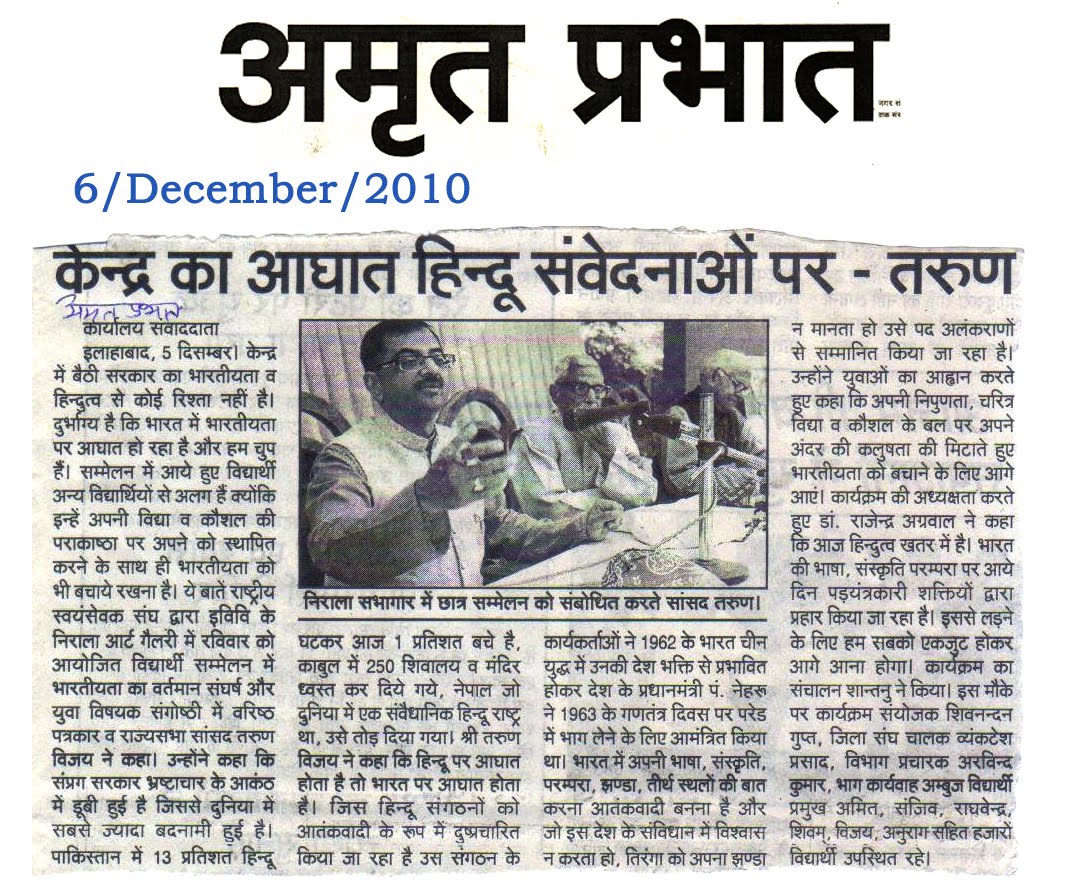
Tarun Vijay in Allahabad(Media Clippings)

06/December/2010


Friday, December 3, 2010

Garhwal Post

01/December/2010

अमर उजाला

30/November/2010

भ्रष्टाचार के विरुद्ध

तरुण विजय


दैनिक जागरण

29/November/2010

नए भारत के उदय की आहट

तरुण विजय

जनसत्ता

28/November/2010

दुख सिर्फ तुम्हारे है

तरुण विजय